Copying data from one application to another is one of the most common, and most tedious, office tasks: a table from a PDF into Excel, an invoice into an ERP form, a customer’s details from an email into a CRM. UiPath Clipboard AI uses AI to understand what you copied and paste it into the right fields of the destination, without building a full automation.
Key takeaways
- Clipboard AI is a free UiPath tool for business users that copies structured data from screens, PDFs and images and pastes it into forms or spreadsheets.
- Since October 2024 it ships as part of UiPath’s Autopilot for Everyone installation rather than as a standalone download.
- It works best for occasional, varied copy-paste work. For high-volume repeated transfers, a proper automation or integration is better.
- Always review the mapped fields before pasting, especially amounts and dates.
What Clipboard AI does
- Copy a whole window or region: a web page, PDF, email or image. AI identifies tables and name–value pairs such as “Invoice number: 4521”.
- Paste into Excel as a clean table, including line items.
- Paste into forms with a mapper that matches source fields to the target form’s fields, so you don’t have to fill each box by hand.
- Handle different layouts without a template, because it reads the content rather than fixed positions.
How to get it today
UiPath originally released Clipboard AI as a standalone preview installer. According to UiPath’s release notes from October 2024, the generally available version is distributed only through the Autopilot for Everyone installation. In practice:
- Sign in to UiPath Automation Cloud (the free Community plan works for individuals).
- Download and install Autopilot for Everyone from the UiPath portal.
- Enable Clipboard AI within it, and allow the browser extension for Chrome or Edge when prompted.
- Your organisation’s admin may need to enable it if you use a company UiPath tenant.
Example: copying an invoice from a PDF into Excel
This walkthrough uses an invoice opened in the browser. The screenshots are from the earlier preview version, so buttons may look slightly different in the current release, but the flow is the same.
- Open the invoice PDF and choose Copy window in Clipboard AI. It analyses the page and shows “Copied to Clipboard AI” when done.
- Open a blank Excel sheet and choose Paste with mapper from the paste options.
- Choose Tables and name-value pairs, since an invoice has both header fields and line items.
- Check the extracted values against the source document, correct anything that’s wrong, then select Paste data.
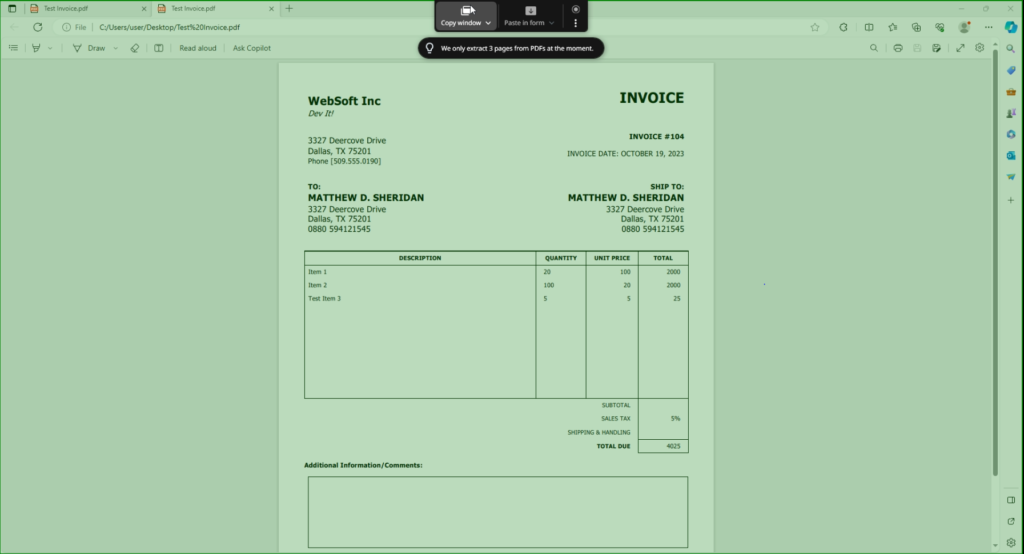
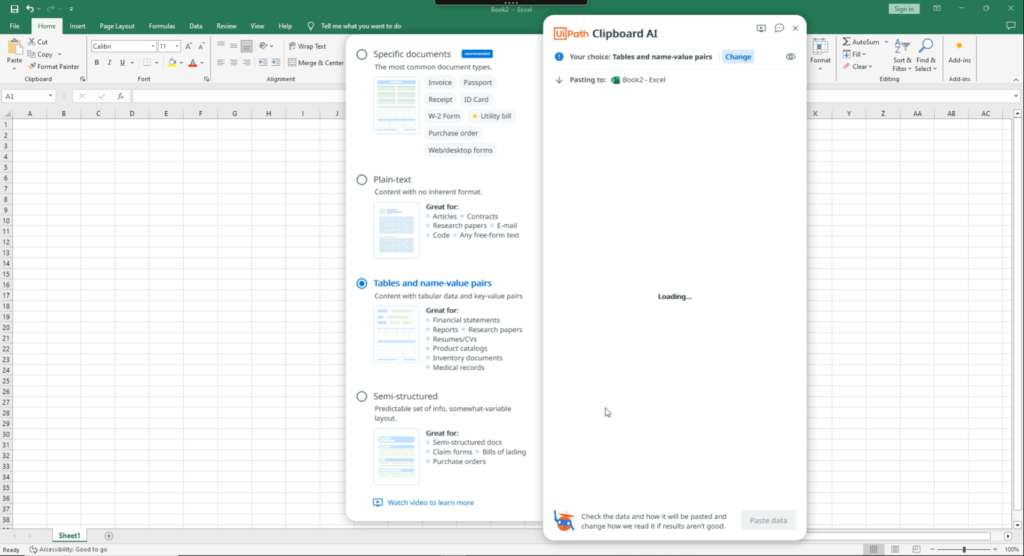
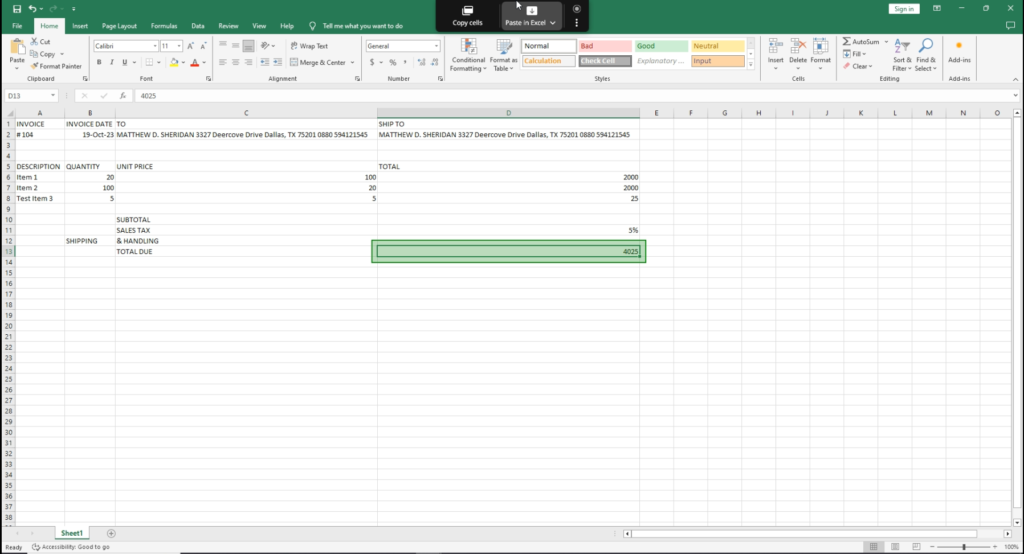
There’s also a video walkthrough of this example on our YouTube channel:
When to use Clipboard AI, and when not to
| Situation | Better choice |
|---|---|
| Occasional copy-paste of varied documents | Clipboard AI |
| Same transfer hundreds of times a day | An RPA bot or API integration |
| Hundreds of invoices in different layouts | Intelligent document processing with a review queue |
| Moving data between two cloud apps | A workflow tool such as Zapier, Make or Power Automate |
Treat AI extraction as a draft. Check totals, tax amounts, dates and account numbers before you paste them into a finance system.
If you’re weighing UiPath against other platforms, see UiPath competitors compared. For automating document-heavy work at scale, read intelligent document automation.
Clipboard AI vs. building a UiPath bot
Clipboard AI and a traditional UiPath robot solve the same problem from opposite ends. A robot is built once by a developer and then runs the same steps thousands of times. Clipboard AI is used by anyone, needs no build, and helps with the one-off or irregular transfers that would never justify a development project.
| Clipboard AI | UiPath robot | |
|---|---|---|
| Who sets it up | The end user | An RPA developer |
| Setup time | Minutes | Days to weeks |
| Best for | Varied, occasional tasks | High-volume, repeatable processes |
| Human involvement | Every run | Exceptions only |
| Handles layout changes | Yes, reads content with AI | Depends on how the bot was built |
Many teams use both: Clipboard AI for ad-hoc work, and a robot once a copy-paste task turns out to happen every day. If you’re not sure which side a task falls on, our list of tasks worth automating is a good starting point.
Tips for better results
- Copy the smallest region that contains the data you need; a whole cluttered screen gives the AI more to misread.
- Use clear, high-resolution source documents. Blurry scans and photos reduce accuracy.
- Rename target form fields or Excel column headers to match the source labels where you can; the mapper matches them more reliably.
- Check numbers formatted with Indian or European separators (1,00,000 or 1.000,00) after pasting.
- For personal or customer data, confirm your organisation allows it to be processed by UiPath’s cloud AI.
Clipboard AI is one of several AI features in UiPath’s platform. For the bigger picture of where RPA and AI meet, read RPA vs intelligent automation.
Frequently asked questions
Is UiPath Clipboard AI free?
It is available to individual users through UiPath’s free Community plan as part of Autopilot for Everyone. Enterprise use depends on your organisation’s UiPath licence.
Does Clipboard AI work on Mac?
UiPath’s desktop tools are primarily built for Windows. Check UiPath’s documentation for current platform support before planning a rollout.
Is my data sent to the cloud?
Clipboard AI uses UiPath’s cloud AI services to understand documents. Check your organisation’s policy before using it with confidential or personal data.






Leave a Reply