If you run a WordPress site, a VPS or a self-hosted automation stack, you need to patch faster than you did last year. On 4 November 2026, reporting on an OpenAI writeup said an unreleased cyber model had demonstrated 948 distinct Linux kernel local privilege escalation bugs, and on 5 November OpenAI published the system card for GPT-6 Cyber.
Key takeaways
- AI-assisted bug discovery is getting cheap and fast; the bottleneck is moving to applying fixes on your own servers.
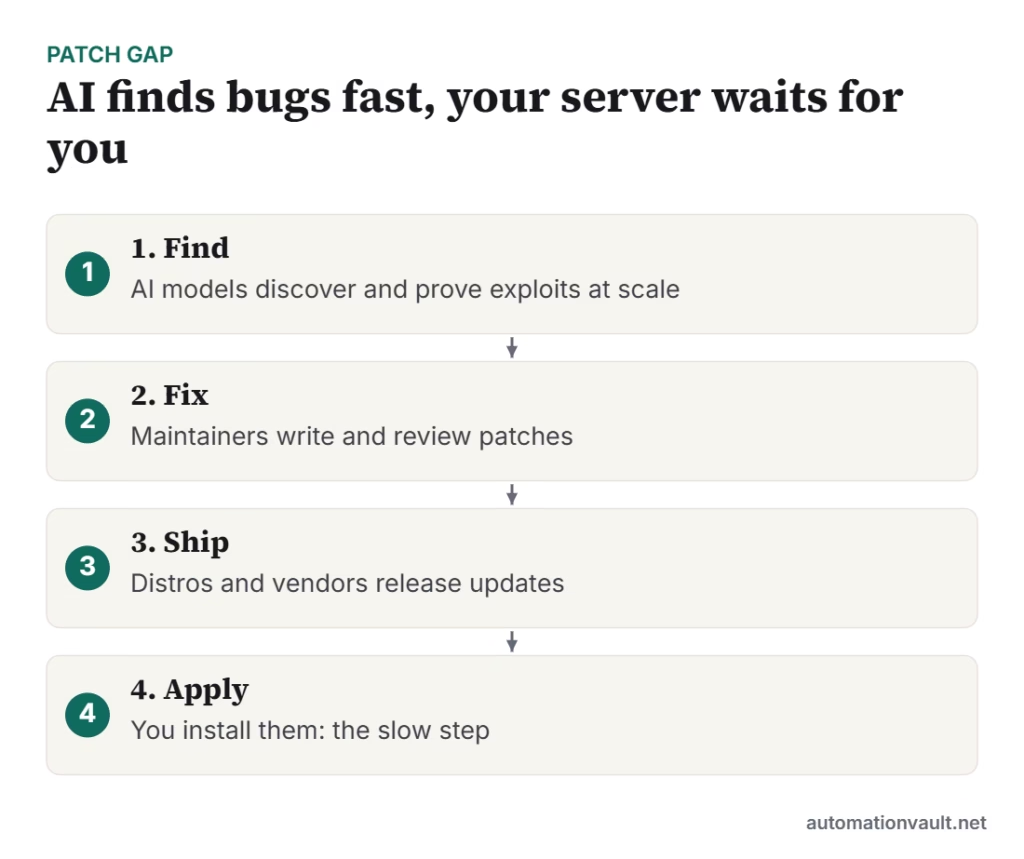
- A fix sitting in a repository does not protect you until your system actually installs it.
- CERT-In’s guidance, as reported, asks for a 12-hour response on known-exploited, internet-facing systems where feasible.
- This week: automatic security updates, an inventory, and a mitigation playbook.
What actually happened
OpenAI’s GPT-6 Cyber system card, published 5 November 2026, describes a cyber-specialised model for authorised security work such as vulnerability discovery and exploit development. OpenAI rates it Critical for cybersecurity under its Preparedness Framework and limits access to approved organisations through its Daybreak Red programme, with identity checks, SSO and MFA, and API IP allowlisting by default.
The card also reports benchmark results, for example 48.45% on ExploitGym against 42.43% for GPT-6 Astra. These are OpenAI’s own figures, not independent tests.
A separate 4 November report, summarised by The Neuron, says an upcoming OpenAI cyber model reproduced 1,724 Linux kernel vulnerabilities and demonstrated 948 distinct local privilege escalation flaws for roughly $1.2 million in API credits, with hundreds of reports and patches submitted upstream. The numbers come from The Neuron’s account of the writeup.
Why you need to patch faster
Local privilege escalation bugs let someone who already has a foothold, such as through a compromised plugin or a leaked SSH key, become root. They are the second half of many breaches. When finding them gets cheaper, more working exploits exist, and the gap between a fix landing and attackers using it can shrink.
The Neuron’s analysis makes the same point: finding a flaw, proposing a fix and protecting real machines are separate steps, and discovery can outrun review and deployment. It also notes Microsoft’s Windows releases covered 2,059 vulnerability entries from August to October 2026, which Microsoft’s Windows chief attributed to rising AI-assisted discovery (counts are not deduplicated). Expect that pressure to reach smaller sites too.
What CERT-In already says about timelines
CERT-In’s 25 May 2026 blueprint on defending against AI-assisted exploitation (CISG-2026-02) is the Indian reference point. According to The Register, it asks defenders to patch, mitigate or remove exposure within 12 hours where feasible for known-exploited bugs on internet-facing or critical systems, and within 24 hours for other critical cases. The document is listed on CERT-In’s site as CISG-2026-02, dated 25 May 2026, so read the full text for the exact wording. Mitigation counts: disabling a service or restricting access is a valid first move.
For related context, see our CERT-In AI agents checklist and the piece on AI agents breaching 100+ websites.
What this means for automation stacks
Self-hosted automation tools such as n8n, Node-RED or cron-driven scripts often run as a single user on a cheap VPS, with API keys sitting in environment files. If an attacker lands on that box through a vulnerable plugin or exposed webhook, a root escalation turns one leaked key into full control of every connected account. That is why the unglamorous work of updating the operating system, container images and workflow tools matters more than any new security product.
A useful habit is to treat your automation server like production infrastructure: one owner, a change log, a weekly update window, and a documented way to switch off public endpoints in minutes. You don’t need a big budget for any of this, just a calendar reminder.
A patch faster plan for this week
- Turn on automatic security updates for the OS (unattended-upgrades or your distro’s equivalent) and for WordPress core and trusted plugins.
- Keep an inventory of servers, plugins, container images and n8n-style automation instances, with versions and owners.
- Plan for kernel restarts. Kernel fixes usually need a reboot or live patching to take effect.
- Write a 12-hour mitigation playbook: how to block a path, disable a plugin or firewall a port fast when a known-exploited bug appears.
- Shrink the foothold: remove unused plugins, rotate API keys, enforce MFA and least privilege.
- Subscribe to your vendor and CERT-In advisories.
If your site handles personal data, a breach also has DPDP consequences. Run our free DPDP website checker to see where you stand.
This is general information, not legal or security advice. The benchmark figures are OpenAI’s own.
Sources
- OpenAI: GPT-6 Cyber system card
- The Neuron: OpenAI Linux findings and Windows patch volume
- The Register: CERT-In 12-hour patching
- CERT-In CISG-2026-02 listing page
Frequently asked questions
Is GPT-6 Cyber available to the public?
No. According to OpenAI’s system card, it is limited to approved users and organisations through Daybreak Red, with identity verification and strict access controls.
Does this mean my Linux server is about to be hacked?
Not by itself. Local privilege escalation usually needs an existing foothold. The risk is that more such bugs get found and exploited, so unpatched systems become easier targets over time.
Is 12-hour patching realistic for a small business?
A full patch often is not, but mitigation can be. CERT-In’s guidance, as reported, allows isolating, restricting or disabling an exposed service where a patch is not ready.
Related posts:
 CERT-In Warns AI Agents Breached Indian Systems: A Security Checklist for Anyone Running Automations
 13 November Is Not Your DPDP Deadline: What Starts and What Doesn’t
 The eMudhra emSign Certificate Distrust: What Happened, Who’s Affected, and How to Check Your Site
 Gemini 4 Argon’s Price Doubles on 1 December: What It Means for Your Automations


Leave a Reply