Supply chains generate huge amounts of data, which makes them a natural fit for AI and automation. From forecasting demand to routing deliveries and processing paperwork, software can speed up decisions and remove manual work. This guide merges our earlier posts on AI in the supply chain, supply chain use cases and RPA for supply chain into one overview.
Key takeaways
- AI is strongest at forecasting, risk detection, routing and document reading; RPA handles repetitive system tasks.
- Start where data is clean and the cost of delay or error is high, such as order processing or inventory planning.
- Visibility across suppliers, stock and shipments is the base for everything else.
- Keep people in the loop for exceptions, supplier relationships and strategic choices.
Top supply chain use cases
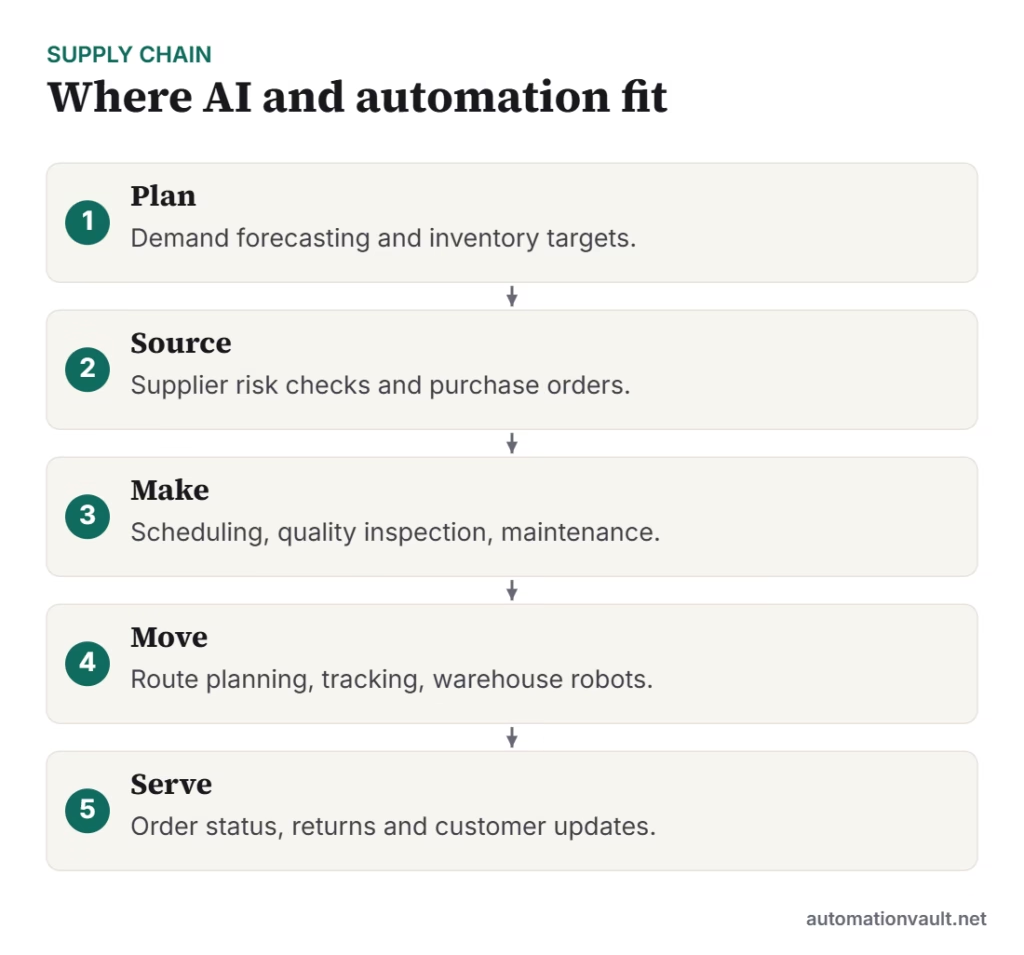
| Use case | What happens | Typical technology |
|---|---|---|
| Demand forecasting | Predict sales by product and region using history, seasonality and events | Machine learning |
| Inventory optimisation | Set reorder points and safety stock to avoid stock-outs and overstock | ML plus rules |
| Supplier risk monitoring | Scan news, financial and delivery data for warning signs | AI and text analysis |
| Order and invoice processing | Read orders, bills of lading and invoices and enter them into systems | Document AI plus RPA; see intelligent document automation |
| Route and load planning | Choose efficient delivery routes and fill vehicles | Optimisation algorithms |
| Warehouse automation | Pick, sort and move goods with robots and conveyors; see cobots | Robotics and vision |
| Predictive maintenance | Service vehicles and equipment before they fail; see AI in Industry 4.0 | Sensors and ML |
| Shipment tracking and alerts | Notify teams and customers of delays automatically | IoT, APIs, workflows |
| Returns handling | Classify returns and trigger refunds or restocking | RPA and rules |
| Sustainability reporting | Collect emissions and sourcing data across partners | Analytics |
RPA in the supply chain
Many logistics processes run across old systems, email and portals. Software robots can create purchase orders, update shipment status, reconcile invoices and download carrier documents without changing the underlying systems. They are quick to deploy and pair well with AI that reads documents; see our RPA strategy roadmap and 40 RPA use cases by department.
Benefits
- Lower inventory and storage costs.
- Fewer delays and stock-outs.
- Faster, more accurate order and invoice handling.
- Earlier warning of disruptions.
- Better use of vehicles and warehouse space.
Challenges
- Data quality: forecasts are only as good as the data behind them.
- Integration: suppliers and carriers use different formats and systems.
- Change management: planners need to trust and understand recommendations.
- Security: shared systems increase exposure; see RPA security.
- Disruption events: models trained on past data can miss unprecedented shocks.
How to start
- Map the end-to-end flow and find the biggest delays or manual steps.
- Choose one use case, such as order entry or demand forecast for top products.
- Check data availability and quality.
- Run a pilot, compare with a baseline and involve the planners.
- Scale to adjacent processes and partners.
For the bigger picture, see business automation and AI and digital transformation trends.
Frequently asked questions
How is AI used in the supply chain?
Mainly for demand forecasting, inventory planning, route optimisation, supplier risk monitoring, document processing and predictive maintenance.
What is the role of RPA in supply chain management?
RPA automates repetitive tasks across systems such as entering orders, updating shipment status and reconciling invoices, without changing the systems themselves.
Where should a company begin with supply chain automation?
Pick one high-volume, well-defined process with good data, such as order processing, run a pilot and measure the results before expanding.



Leave a Reply