AI, automation and flexible working are changing what work looks like. Studies by organisations such as the World Economic Forum and McKinsey suggest that many tasks will be automated while new roles appear, though forecasts differ and should be treated as estimates. This article merges our two earlier posts on the future of work and sets out the main shifts and how to prepare.
Key takeaways
- Automation targets tasks, so most jobs change rather than disappear.
- Skills in data, AI use, problem solving and communication are in demand.
- Hybrid and remote work have become standard in many sectors.
- Employers and workers both need a plan for continuous learning.
Main shifts
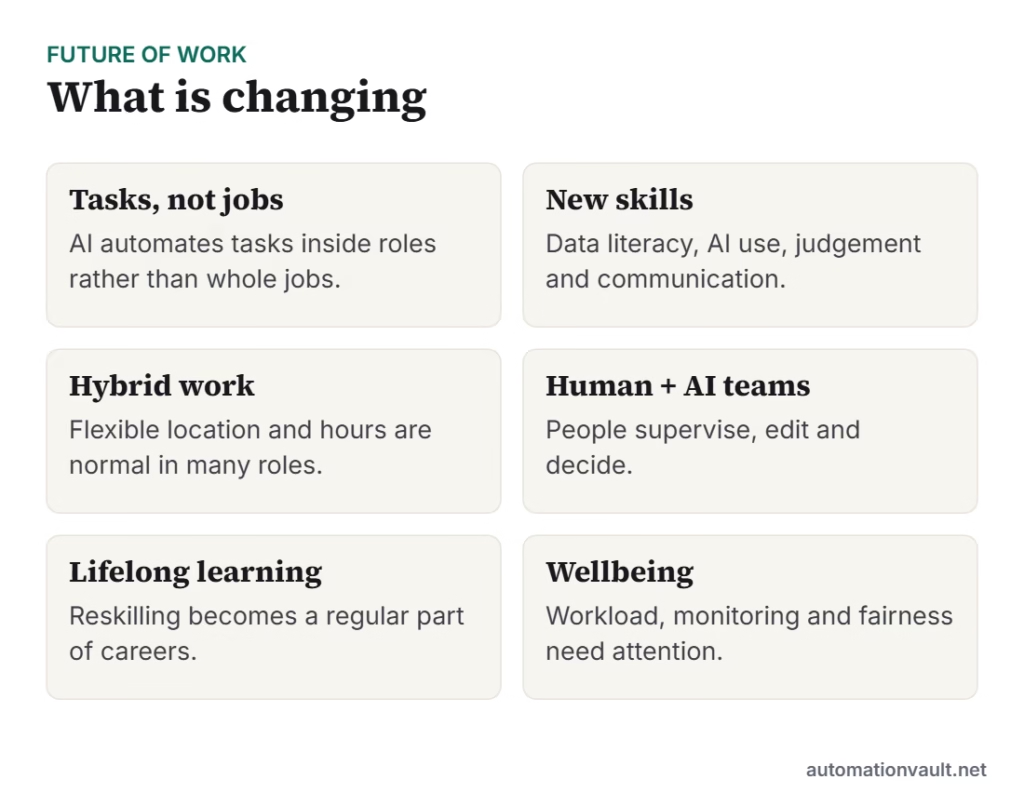
Tasks are automated, jobs evolve
Most jobs contain a mix of tasks. Repetitive, rules-based ones are easiest to automate, such as data entry or routine reporting; see business automation and AI and 40 RPA use cases by department. Work that needs judgement, empathy or creativity changes more slowly.
Humans and AI work together
AI assistants draft, summarise and analyse, while people set goals, check results and make decisions. Knowing how to prompt and review is becoming a general workplace skill; see ChatGPT use cases.
Flexible and hybrid work
Many organisations offer remote or hybrid options, widening the talent pool and changing office needs. It also demands clear communication, trust and good tools.
New and growing roles
- Data analysts and AI specialists.
- Automation developers and process owners; see freelance automation jobs.
- Cybersecurity professionals.
- Roles in healthcare, renewable energy and care, where human presence is central.
Skills to build
| Skill area | Examples |
|---|---|
| Technical | Data literacy, spreadsheets, basic scripting, AI tools |
| Cognitive | Critical thinking, problem solving, learning agility |
| Human | Communication, collaboration, empathy, leadership |
| Process | Mapping workflows and spotting automation chances |
How workers can prepare
- Learn how AI tools apply to your role and use them on small tasks.
- Take short courses or projects in data and automation.
- Build a portfolio of results, not just a list of duties.
- Network inside and outside your field.
How employers can prepare
- Map which tasks are likely to change in each role.
- Offer reskilling and time to learn.
- Involve staff in choosing and designing automation.
- Set clear policies on AI use, privacy and monitoring.
- Measure wellbeing and workload as well as productivity.
A realistic view of the numbers
Headline forecasts vary widely because they depend on assumptions about adoption speed, regulation and economic conditions. Rather than relying on one prediction, look at your own tasks: which take the most time, which follow clear rules and which depend on relationships? That analysis tells you more about your future than any global estimate.
For the technology side, see digital transformation trends and the main branches of AI.
Frequently asked questions
Will AI take my job?
AI is more likely to change the tasks in your job than remove it entirely, but some roles will shrink. Building skills that complement AI helps.
What skills will be most valuable?
Data literacy, ability to work with AI tools, problem solving, communication and adaptability.
Is remote work here to stay?
Many organisations keep hybrid models, though policies vary by company and role.





Leave a Reply