Industry 4.0 describes factories where machines, sensors, software and people are connected and share data. Artificial intelligence is the part that makes sense of that data: it predicts failures, checks quality and helps plan production. This article explains the main uses, the benefits and the practical steps to start.
Key takeaways
- Industry 4.0 combines IoT, cloud or edge computing, data analytics, robotics and AI.
- The best-proven uses are predictive maintenance, visual quality inspection and demand-driven planning.
- Start with one costly problem and good data, not a factory-wide overhaul.
- Skills, data quality and cybersecurity are the usual obstacles, not the algorithms.
What is Industry 4.0?
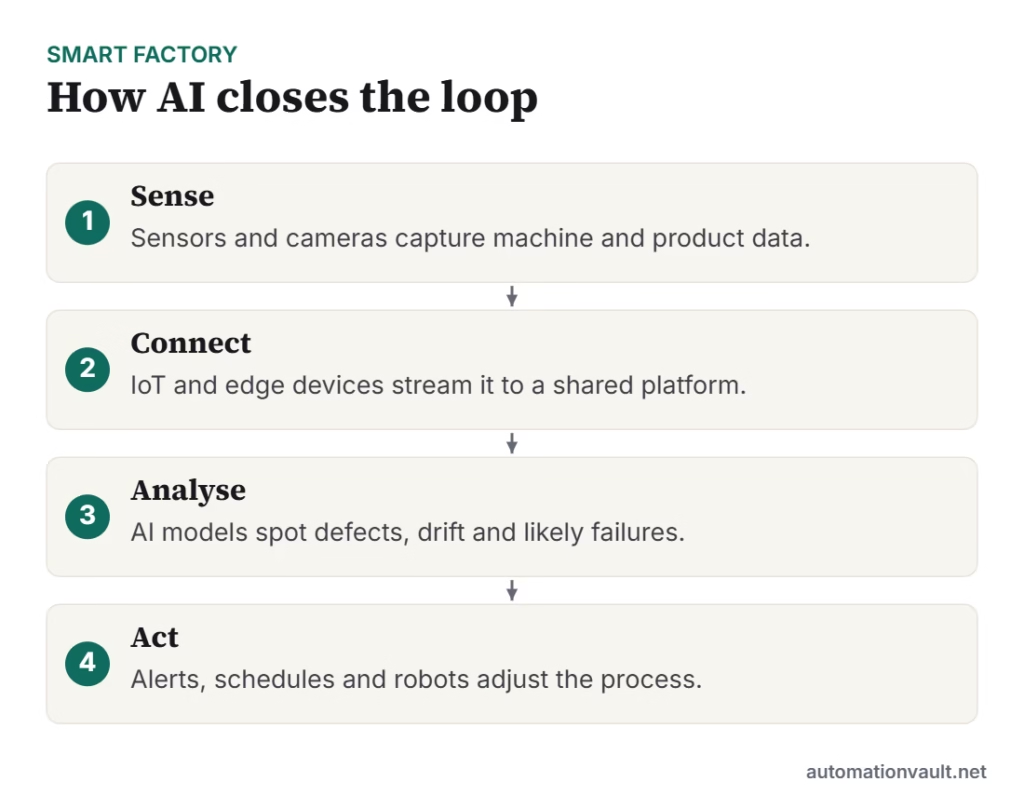
The term describes the fourth industrial stage, following mechanisation, mass production and computer automation. Its building blocks are connected machines (the Industrial Internet of Things), data platforms, analytics and AI, and flexible automation such as robots and 3D printing.
Where AI is used
| Use | What AI does | Typical benefit |
|---|---|---|
| Predictive maintenance | Learns patterns in vibration, temperature and current to flag likely failures | Less unplanned downtime |
| Visual quality inspection | Spots defects in images faster than manual checks; see computer vision challenges | Fewer defects reach customers |
| Demand and production planning | Forecasts demand and suggests schedules | Lower stock and fewer shortages |
| Process optimisation | Tunes settings such as speed and temperature | Less waste and energy use |
| Robotics | Guides robots and cobots to adapt to variation; see collaborative robots | More flexible lines |
| Supply chain visibility | Predicts delays and risks; see supply chain automation | Faster response to disruption |
Benefits
- Higher uptime and equipment life.
- More consistent quality and less scrap.
- Faster, data-based decisions.
- Safer work, as machines take on hazardous or repetitive tasks.
Challenges
- Data: old machines may lack sensors, and data is often scattered across systems.
- Skills: teams need people who understand both operations and data.
- Integration: connecting legacy equipment, ERP and new tools takes work.
- Cybersecurity: connected plants widen the attack surface.
- Change management: operators must trust and use the tools.
How to get started
- Pick one measurable problem, such as a machine that causes frequent stoppages.
- Check what data already exists and fill gaps with low-cost sensors.
- Run a pilot on one line and compare against a baseline.
- Involve operators and maintenance staff from the start.
- Plan security and data ownership before scaling.
Software robots also support the back office around the factory, as covered in our RPA strategy roadmap. For an overview of the AI techniques involved, see the main branches of AI.
Example: predictive maintenance on a packaging line
A packaging plant suffers unplanned stoppages when a motor bearing fails. By fitting vibration and temperature sensors and feeding the readings to a model trained on past failures, the team receives an alert days before a breakdown. Maintenance is then scheduled in a planned stop. The value comes not from the algorithm alone but from reliable data, clear alert thresholds and a maintenance team that acts on the warning.
Key technologies behind Industry 4.0
- Industrial IoT: sensors and gateways that collect machine data.
- Edge computing: processing close to the machine when latency matters.
- Cloud platforms: storage and analytics at scale.
- Digital twins: virtual models of machines or lines used to test changes safely.
- Generative AI: assistants that summarise maintenance logs or answer questions about procedures; see generative vs predictive AI.
Measuring success
Choose a few clear metrics before you start: overall equipment effectiveness (OEE), unplanned downtime hours, scrap rate, first-pass yield and energy per unit produced. Record a baseline, then compare after the pilot. If the numbers do not move, adjust the use case before scaling.
Industry 4.0 projects succeed when they target a real production problem, use trustworthy data and give operators tools they find useful. Technology alone rarely delivers the result.
Frequently asked questions
What is the role of AI in Industry 4.0?
AI analyses the data from connected machines to predict failures, inspect quality, optimise processes and plan production.
Do I need new machines for Industry 4.0?
Not always. Many older machines can be retrofitted with sensors and gateways, so you can begin without replacing equipment.
What is the difference between Industry 4.0 and automation?
Traditional automation follows fixed rules. Industry 4.0 adds connectivity and data-driven learning so systems can adapt and improve.




Leave a Reply