Google made Gemini 4 Argon generally available on 13 October 2026 at an introductory price of $2 per million input tokens and $10 per million output tokens. That introductory period ends on 30 November. From 1 December, Google’s documentation lists $4 and $20, exactly double. If you have an automation that calls this model with your own API key, your bill for the same work will double in about five weeks. This post shows what that looks like in numbers and what you can do about it.
Key takeaways
- Gemini 4 Argon costs $2 in / $10 out per million tokens until 30 November 2026, then $4 / $20, according to Google’s developer documentation.
- Thinking tokens are billed as output tokens, so a model that “thinks” a lot costs more per task than the headline rate suggests.
- At the introductory rate it matches the list prices of Claude Sonnet 5.5 and GPT-6.1 Sol ($2 / $10). After 1 December it costs the same as Claude Opus 5.5 ($4 / $20).
- You can cut costs without changing models: batch processing, caching, shorter prompts, and capped output.
The prices, side by side
These are the standard-tier list prices from each provider’s own documentation, per million tokens, as of 25 October 2026. Check the vendor pages before you budget, since prices change.
| Model | Input | Output | Cached input | Batch discount |
|---|---|---|---|---|
| Gemini 4 Argon (to 30 Nov) | $2 | $10 | $0.10 | 50% |
| Gemini 4 Argon (from 1 Dec) | $4 | $20 | $0.20 | 50% |
| Claude Sonnet 5.5 | $2 | $10 | $0.10 | 50% |
| Claude Opus 5.5 | $4 | $20 | $0.20 | 50% |
| Claude Haiku 5.5 (prompts up to 100,000 tokens) | $0.10 | $0.50 | $0.01 | 50% |
| GPT-6.1 Sol | $2 | $10 | $0.10 | 50% (Batch and Flex) |
Sources are listed at the end. Gemini 4 Argon is available on the paid API tier only, not the free tier, and has a 1,048,576-token context window shared by input, thinking and output.
A worked example
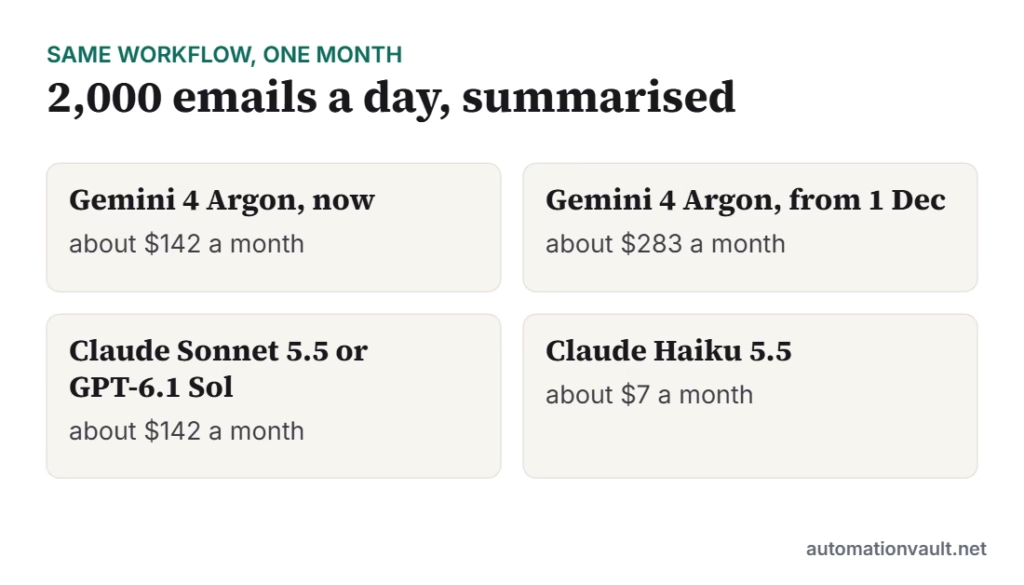
Take a workflow that summarises 2,000 customer emails a day. Assume each email is about 400 words (roughly 530 tokens, using the rule of thumb from our guide to what AI tokens are) and each summary is about 100 words (roughly 130 tokens). That is about 1.06 million input tokens and 0.26 million output tokens a day, or roughly 31.8 million input and 7.8 million output tokens over a 30-day month.
| Model | Input cost | Output cost | Monthly total |
|---|---|---|---|
| Gemini 4 Argon, now | $63.60 | $78.00 | $141.60 |
| Gemini 4 Argon, from 1 Dec | $127.20 | $156.00 | $283.20 |
| Claude Sonnet 5.5 / GPT-6.1 Sol | $63.60 | $78.00 | $141.60 |
| Claude Opus 5.5 | $127.20 | $156.00 | $283.20 |
| Claude Haiku 5.5 | $3.18 | $3.90 | $7.08 |
These figures are illustrative. They assume no reasoning or “thinking” tokens, no caching and no batching. Real costs depend on your prompts, and a model that produces long hidden reasoning will cost more per task than this table shows.
The point is not that one model is the right choice. Summarising short emails is easy work, and a small model may do it well enough for a fraction of the cost. A harder task, such as extracting figures from messy contracts, may justify a larger model. Test each option on your own samples before you decide.
Why per-token price is not the whole story
Google’s documentation says thinking tokens are billed at the output rate. A model that reasons at length before answering can therefore spend many more output tokens per task than one that answers directly. When you compare models, compare the cost of finishing a real task, not just the price per million tokens.
Seven ways to keep the bill down
- Use batch processing for work that can wait. All three providers list a 50% batch discount, which suits overnight reports and bulk classification.
- Turn on caching. Gemini applies implicit caching, with a 95% discount on cached input, to prompts of at least 4,096 tokens, so keep the fixed part of your prompt at the start and the changing part at the end.
- Trim your prompts. Remove repeated instructions and pasted boilerplate, and send only the relevant part of long documents.
- Cap the output. Ask for a fixed format and length, and set a sensible maximum, and remember that thinking tokens are billed as output.
- Route by difficulty. Send simple tasks to a small, cheap model and only escalate hard ones to a larger model.
- Pin the model and watch usage. Use a specific model name rather than a “latest” alias, and set a budget alert in your provider console.
- Re-run your estimate on 1 December. Update your costings now so the change does not surprise you.
If your automations run on a platform that bundles AI credits instead of using your own key, check how that platform prices model usage, since the pass-through may differ. For the wider picture of how these costs fit into tool choices, see our comparison of workflow automation tools and our guide to business automation and AI.
This post gives general information, not financial or procurement advice. Prices were checked against the sources below on 25 October 2026 and may have changed.
Sources
- Google AI for Developers: What’s new in Gemini 4 Argon (primary source for pricing and thinking-token billing)
- Google: Gemini 4 Argon is now available for everyone
- Claude Platform Docs: Pricing
- OpenAI API docs: GPT-6.1 Sol
Frequently asked questions
How much does Gemini 4 Argon cost?
Until 30 November 2026 it is $2 per million input tokens and $10 per million output tokens. From 1 December, Google’s documentation lists $4 and $20.
Are thinking tokens charged?
For Gemini 4 Argon, yes. Google says they are billed as output tokens, so they cost the output rate.
How can I lower my AI model costs without switching models?
Use batch processing for non-urgent work, take advantage of caching, shorten prompts, cap output length, and send easy tasks to a cheaper model.



Leave a Reply