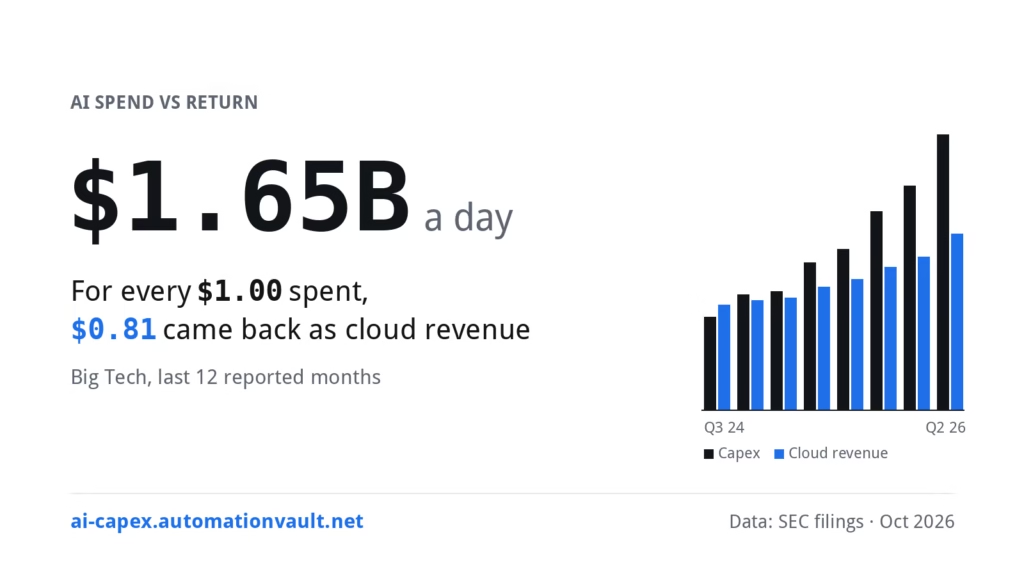
Microsoft, Alphabet, Amazon, Meta and Oracle spent $601 billion on property and equipment over their last four reported quarters. That works out to about $1.65 billion a day, or $69 million every hour, most of it going into AI data centers.
Everyone reports the spending. I wanted to know the other half: how much of it is coming back? So I built a small tracker that reads the companies’ SEC filings every night and puts spend and return side by side. The short answer: for every $1.00 the four cloud providers spent, $0.81 came back as cloud revenue. The live tracker is here. It’s free, has no sign-up, and updates itself.
The numbers, as of October 23, 2026
| Metric (last 12 reported months) | Value | Change vs a year ago |
|---|---|---|
| Capex, all five companies | $601B | +83% |
| Cloud revenue (AWS, Microsoft Intelligent Cloud, Google Cloud, Oracle cloud) | $402B | +35% |
| Free cash flow after capex | $109B | −43% |
| Depreciation | $169B | +41% |
Spending is growing more than twice as fast as the revenue it is meant to earn. Over the last eight quarters, combined quarterly capex went from $61 billion to $182 billion, about 3×. Quarterly cloud revenue went from $69 billion to $116 billion, about 1.7×.
Return per dollar, company by company
“Return per $1” is a company’s cloud segment revenue divided by its capex over the same 12 months. It’s crude, because a data center built today earns for years, but it shows who is closest to paying for the build-out.
- Microsoft: $1.19. The only one above $1. Its Intelligent Cloud segment also includes server software licences, which flatters the ratio a little.
- Amazon: $0.86. AWS brought in $148B against $173B of capex, and Amazon’s capex also covers warehouses and logistics.
- Alphabet: $0.59. Google Cloud is growing fastest (+58%), but capex doubled year on year.
- Oracle: $0.51. Capex of $76B is up 176% in a year, against $38B of cloud revenue.
- Meta: no cloud business. Its $104B of capex has to pay off through advertising. Meta reported Q3 2026 capex of $33.9B on October 22, up 80% year on year.
Where the cash is going
Two numbers stood out to me. Amazon’s free cash flow after capex is now negative (−$11.6B over 12 months, down from +$13.5B). Oracle’s is −$28.7B. Both are spending more on buildings and chips than their operations bring in. Across all five, free cash flow after capex has fallen 43% in a year, even as revenue keeps growing.
Depreciation is the delayed cost. Today’s GPUs and buildings get expensed over the next several years. Combined depreciation is already $169B a year and rising 41%, so it will keep eating into profits even if spending slows.
Follow the money: who receives it
The other side of the trade is the suppliers. The tracker compares each one’s last-12-month revenue with Big Tech’s combined capex:
- Nvidia: $303B revenue (+83%). That’s equal to about half of the five companies’ capex.
- Micron: $133B (+256%), driven by high-bandwidth memory.
- Broadcom: $89B (+49%), from custom AI chips and networking.
- AMD: $41B (+40%).
- Vertiv: $11.5B (+26%), from power and cooling.
These suppliers also sell to other customers, so this isn’t an exact split. It does show where the scale is: the spending is real revenue for someone today, even if the return for the spenders is still catching up.
In perspective
- 2.3× the Apollo program, every 12 months. Apollo cost about $257B in 2020 dollars, by the Planetary Society’s estimate.
- 14.2 GW of AI data center power already running across the 95 sites in Epoch AI’s database. That’s roughly 14 large nuclear reactors’ worth.
- The biggest single site in that data is Amazon’s New Carlisle campus for Anthropic (Project Rainier), at about 1 GW.
How the tracker works
It’s deliberately boring. A PHP script runs once a night on my web host and does three things:
- Pulls each company’s XBRL data from SEC EDGAR’s free API, including capex, operating cash flow and depreciation.
- Reads the segment tables in each 10-Q and 10-K to get cloud revenue (AWS, Intelligent Cloud, Google Cloud, Oracle cloud).
- Downloads Epoch AI’s open Frontier Data Centers dataset and compares it with yesterday’s copy to catch new sites and changes.
No AI writes or estimates any number on the page. Everything is computed from filings and the Epoch dataset, and each figure is labelled with what it includes.
What it can’t tell you
- It isn’t AI-only spend. No company reports that number, so the tracker uses total capex.
- Leases are excluded. Microsoft and others fund part of their build-out through finance leases, so true spend is higher.
- Forward guidance is entered by hand, because it comes from earnings calls, not filings.
What to watch next week
Microsoft, Alphabet and Amazon report their September-quarter results between October 28 and 30. When their 10-Qs land, the tracker updates on its own. Watch whether return per dollar keeps sliding or starts to turn. I’ll write up what changed once the numbers are in.
FAQ
Why only these five companies?
They file quarterly XBRL data with the SEC, so their numbers can be pulled automatically and compared like for like. Chinese hyperscalers and private labs don’t, so they’re left out for now.
Is a return of $0.81 per dollar bad?
Not by itself. Data centers earn for 10 years or more, so one year of revenue against one year of spending will always look thin during a build-out. The trend is what matters, and that’s why the tracker shows it quarter by quarter.
How often does it update?
The script runs every night. Company numbers change four times a year, when each company files. The data center list changes whenever Epoch AI updates its dataset.
Sources
- SEC EDGAR: 10-Q and 10-K filings for Microsoft, Alphabet, Amazon, Meta, Oracle, Nvidia, Broadcom, AMD, Micron and Vertiv
- Epoch AI, Frontier Data Centers (CC BY 4.0)
- The Planetary Society: How much did the Apollo program cost?
Figures are as of October 23, 2026 and change as companies file. See the live tracker for the current numbers. This post is general information, not investment advice. The tracker is independent and not affiliated with any of the companies mentioned.
Related posts:
 UiPath Competitors: 7 Alternatives Compared (and How to Choose)
 10 WhatsApp Automation Use Cases for Businesses (and How Pricing Works Now)
 Workflow Automation Tools Compared: Zapier vs Make vs n8n vs Power Automate
 Is Your Website Ready for India’s DPDP Rules? I Built a Free Scanner (My Blog Scored 29/100)


Leave a Reply