
The emBridge flaw is the second eMudhra security story in a month, and this one touches the small desktop utility many Indian professionals use to sign on government portals. CERT-In issued a vulnerability note on 13 November 2026 (ID CIVN-2026-0549, rated low), and eMudhra says it shipped a fix on 11 November. If you use a USB digital signature token, the action is simple: check your emBridge version and update.
Key takeaways
- What it is: emBridge, eMudhra’s utility that connects portals to DSC tokens, had file-browsing functions that did not check who was asking.
- Impact (per CERT-In, as reported): someone on your local network could see file and folder names, not read, change or delete files, run code, or reach keys or token PINs.
- Severity: CERT-In rated it low. The reporting researcher called it trivial and said the vendor downplayed it, which is his opinion.
- Action: update to Windows 5.9.4.x, macOS 3.2.7.x or Linux 3.3.1.x or later.
What the emBridge flaw is
emBridge relays requests between your browser and the USB token holding your digital signature certificate. According to reports of the CERT-In note, several file-browsing functions did not verify that requests came from an authorised source, and on Windows those functions run with the highest system privileges. A malicious web page could therefore call emBridge’s local HTTPS API and get a listing of file, folder and drive names from the machine.
Reports say the exposure stops there. CERT-In states the flaw does not allow reading file contents, modifying or deleting files, executing code, or obtaining cryptographic keys or token PINs. eMudhra’s fix removed the file-browsing endpoints entirely.
Who is affected and what to install
| Platform | Vulnerable versions | Update to |
|---|---|---|
| Windows | 5.9.1.x to 5.9.3.x | 5.9.4.x or later |
| macOS | 3.2.4.x to 3.2.6.x | 3.2.7.x or later |
| Ubuntu / Red Hat | 3.2.0.x to 3.3.0.x | 3.3.1.x or later |
Government portals such as MCA, DGFT and the National Single Window System rely on this kind of utility, so accountants, company secretaries, exporters and small-business owners are the realistic user base.
How serious is it? Two views
The vendor’s position, as reported: the impact is low, and exploitation needs four things at once, shown below. eMudhra also says its firewall and local-only request handling block direct access from other machines, and that every certificate use needs a token PIN.
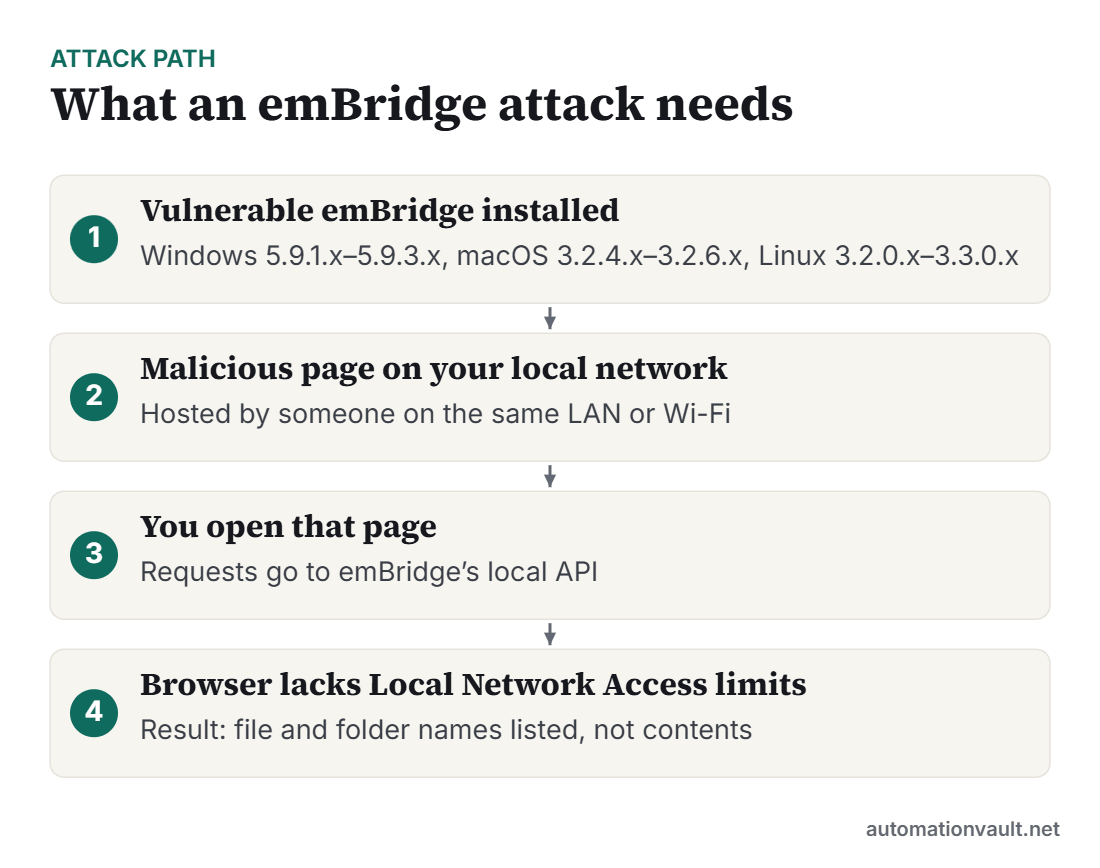
The counter-view is that file names alone can be revealing. Folder names such as client names, tax years or contract titles tell an attacker what is worth targeting next. That is my interpretation, not a finding from the advisory. The honest summary is a low-severity bug that is cheap to close, so close it.
Why this matters beyond one bug
The flaw is in eMudhra’s domestic signing stack, which authorities had said was not affected by the October certificate-key incident. That incident was separate: eMudhra’s TLS and code-signing intermediate CA keys were generated with weak randomness, and CERT-In’s advisory CIAD-2026-0050 covers it. I covered the website side in our eMudhra SSL exit post. Treat the two as different problems with the same vendor: one for site owners, one for DSC users.
For teams, the cheapest win is an inventory. Ask whoever handles filings which machines have a DSC token and emBridge installed, note the version on each, and set a reminder to recheck after every vendor advisory. Signing utilities sit outside normal patch tools on many small-office PCs, so they tend to drift for months. A one-line checklist in your compliance folder is enough to stop that.
What to do this week
- Check your version: open emBridge on each machine used for signing and compare it with the table above.
- Update: install the fixed build from eMudhra’s official site, not from a link in an email or message.
- Avoid shared networks while signing: do not leave a DSC token plugged in on café, coworking or guest Wi-Fi when you do not need it.
- Keep your browser current: eMudhra’s conditions include a browser without Local Network Access restrictions, so browser updates reduce exposure.
- Site owners: if you run HTTPS sites, run your domain through the emSign certificate checker to see whether your chain touches the revoked eMudhra intermediates or root.
This is general information, not legal or security advice. Confirm versions and fixes with eMudhra and the CERT-In note before acting.
Sources
- MediaNama: CERT-In flags new security flaw in eMudhra’s emBridge
- Inc42: CERT-In flags fresh vulnerabilities in eMudhra’s emBridge tool
- The420.in: vulnerability in eMudhra utility exposed local file and folder names
- CERT-In advisory CIAD-2026-0050 (October incident)
Verification note: I could not open the CERT-In note CIVN-2026-0549 itself, so the details above rely on three consistent news reports of it. eMudhra’s own advisory was also not opened.
Frequently asked questions
Does the emBridge flaw let attackers steal my digital signature?
Per the CERT-In note as reported, no. It does not expose cryptographic keys or token PINs, and each certificate use needs a PIN. It lists file, folder and drive names only.
Do I need to be on the same network as the attacker?
Yes, according to the advisory and eMudhra’s stated conditions: the attacker needs a malicious page on your local network, and you must open it.
Is this related to the October eMudhra certificate incident?
Same vendor, different problem. The October incident concerned weak keys for TLS and code-signing intermediate CAs. This one is a local utility bug.
Related posts:
 The eMudhra emSign Certificate Distrust: What Happened, Who’s Affected, and How to Check Your Site
 eMudhra Is Leaving the SSL Business: What to Do Before 27 October
 CERT-In Warns AI Agents Breached Indian Systems: A Security Checklist for Anyone Running Automations
 AI Found 948 Linux Root Flaws: Patch Faster Now

Leave a Reply